


How Clients Find Service-Based Businesses Today
- 3 days ago
- 3 min read

If you're still relying on social media alone to bring in new clients, you may be missing how consumer behavior has changed.
A few years ago, posting consistently on social media could generate a steady flow of inquiries.
Today?
People research differently.
They compare differently.
And they buy differently.
The reality is that most service-based businesses aren't losing clients because they're bad at what they do.
They're losing clients because they're invisible during the moments people are actively looking for help.
Let's look at how clients actually find service providers today.
1. Google Is Still the First Stop
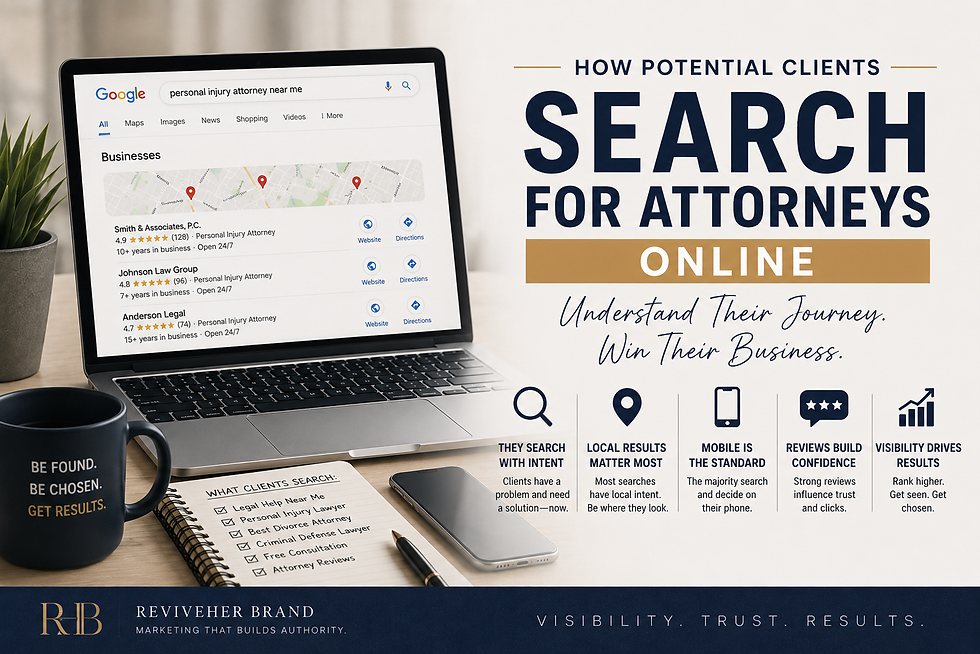
When someone needs an attorney, consultant, accountant, contractor, designer, or coach, they usually don't start on Instagram.
They start with a search.
Examples include:
Family lawyer near me
Website designer for small business
Estate planning attorney in Chicago
Marketing consultant near me
Best divorce lawyer in my area
People search because they have a problem they want solved.
That makes Google one of the highest-intent platforms available.
These are not casual browsers.
These are potential buyers.
If your business isn't showing up in search results, you're missing opportunities before the conversation even starts.
2. Your Website Is Often Your First Impression
After finding your business, most people immediately visit your website.
This is where many service providers lose potential clients.
Your website answers critical questions:
Are you legitimate?
Do you specialize in my problem?
Can I trust you?
What will it be like to work with you?
How do I contact you?
A website isn't just a digital brochure anymore.
It's your credibility.
People often decide whether to contact you before they ever speak to you.
3. Online Reviews Influence Buying Decisions
Consumers trust other consumers.
Before hiring a business, many people read reviews to validate their decision.
They want reassurance that:
You deliver results
You communicate well
You are professional
Others had a positive experience
A strong review profile often becomes the deciding factor between two businesses offering similar services.
That's why Google reviews, testimonials, and case studies matter more than ever.
4. Referrals Now Come With Research
Referrals are still powerful.
But referrals have changed.
Years ago, a recommendation from a friend was often enough.
Today, people receive the referral and then immediately research the business online.
Think about your own behavior.
If someone recommends a business, what's the first thing you do?
You Google them.
That means your online presence either confirms the referral—or weakens it.
Even warm leads often need digital proof before they move forward.
5. Social Media Supports Trust—It Doesn't Always Create It
Many business owners spend most of their marketing energy on social media.
The problem?
Most consumers aren't actively looking to hire someone while scrolling.
Social media is valuable because it helps people:
Stay familiar with your brand
Learn from your expertise
Build trust over time
See your personality
But social media usually supports the buying decision rather than creating it.
Your audience may discover you on social media and then visit your website, Google Business Profile, reviews, or LinkedIn page before contacting you.
6. Content Helps You Get Found
Blog articles, FAQs, videos, and educational content help businesses show up when people are searching for answers.
For example:
A business owner searching:
"Why isn't my website generating leads?"
May discover a blog article.
Read it.
Learn from it.
Trust the company.
And eventually become a client.
Good content works because it answers questions before prospects ever reach out.
It positions you as the expert before the sales conversation begins.
7. Consistency Creates Confidence
Consumers notice inactive businesses.
An outdated website.
A neglected Google profile.
A social media page that hasn't been updated in months.
These things create uncertainty.
People naturally wonder:
"Are they still in business?"
"Are they paying attention?"
"Will they respond?"
Consistency signals professionalism.
And professionalism builds trust.
The Modern Client Journey
Today's client journey often looks something like this:
Identify a problem
Search Google
Visit a website
Read reviews
Check social media
Compare competitors
Contact the business
Most people don't discover a business and immediately buy.
They investigate first.
The businesses that consistently win are the ones that show up at every step of the journey.
My Final Thoughts
The way people find service-based businesses has evolved.
It's no longer about being active on one platform.
It's about building a complete online presence that creates visibility, trust, and credibility.
Your website, reviews, Google Business Profile, content, and social media all work together.
The businesses attracting the most clients today aren't necessarily the loudest.
They're the easiest to find and the easiest to trust.


Comments